
E-E-A-T Defined: Building Business Authority in the Age of AI
Establishing E-E-A-T signals is essential for maintaining your website’s credibility and visibility in an increasingly automated search landscape. As AI discovery tools prioritize verifiable expertise over generic content, clear authority becomes a primary business differentiator. Implementing these strategic trust signals ensures your brand remains a recognized and cited leader.

Written by Carissa Krause
Last updated March 17, 2026 • First published January 26, 2024

TL;DR – Key Takeaways for E-E-A-T
- Experience, Expertise, Authoritativeness, and Trustworthiness (E-E-A-T) are the primary quality benchmarks used by search engines to evaluate content reliability.
- Trust is the most critical pillar, functioning as the baseline requirement for all service-based and lead-generation websites.
- First-hand experience distinguishes human-led insights from generic AI-generated content, making it a vital signal for modern search visibility.
- Entity-based SEO prioritizes verifiable credentials, such as professional certifications and recognized industry associations, over traditional keyword density.
- Semantic depth and clear topic ownership are essential for appearing in AI-driven discovery and search generative experiences
The way information is discovered has undergone a profound shift. As AI-driven search generative experiences become the standard in 2026, Google’s criteria for quality content have become more sophisticated. It is no longer sufficient to simply answer a question. You must prove it has the standing, the practical background, and the real-world evidence to be the definitive source for that answer.
This evolution is centered on E-E-A-T. While the acronym has existed for years, its application today is the single most important factor for visibility. Based on our work with Canadian businesses across multiple industries, we have seen that those who prioritize these trust signals maintain significantly more stable visibility during major algorithm shifts.
For the modern marketing decision-maker, understanding E-E-A-T is not about learning a technical hack but about aligning a brand’s digital presence with the high standards of verification required in an environment where AI filters out superficial information.
Note: This guidance is specifically written for small to mid-sized Canadian service-based and lead-generation businesses navigating the transition to AI-driven search and entity-based discovery in 2026.
A Little Background: How AI-Driven Discovery and Entity-Based Search Have Transformed SEO
The most significant shift in search behavior is the move toward entity-based discovery.
Search engines and AI models no longer view content as a collection of strings and keywords. Instead, they interpret content as a web of interconnected entities: people, brands, places, and concepts.
Moving From Simple Keyword Matching to Semantic Information Retrieval
In the past, SEO often focused on repeating specific terms to gain visibility. Today, AI systems prioritize semantic structure. They look for signals that confirm a business actually possesses the expertise it claims. Surface-level content (often produced in high volume but with low insight) is being deprioritized in favor of depth and verifiable accuracy.
LIKE WHAT YOU’RE READING?
If these articles are helpful,
imagine what our team
can do for you!
Let’s identify the quick wins you can easily apply to your website.


Not Sure What Your Website Needs Anymore?
Search has changed. AI tools are influencing visibility. Let’s clarify what actually matters for your business now.
Not Sure What Your Website Needs Anymore?
Search has changed. AI tools are influencing visibility. Let’s clarify what actually matters for your business now.
The Rising Significance of the “Experience” Signal in an Automated Content Landscape
The addition of the second “E” (Experience) was a direct response to the proliferation of generic content. In an age where AI can generate a competent-sounding summary of any topic, the distinguishing factor for a business is its unique, first-hand experience. Search systems now prioritize evidence of real-world application, such as case studies, proprietary data, and professional perspective.
What Still Matters: Foundational Search Principles That Remain Critical for Business Credibility
Despite the rapid advancement of AI, the fundamental goal of SEO remains the same: connecting a user with the most trustworthy solution to their problem. Certain principles have not disappeared. They have simply matured.
- Trust as the Primary Pivot: Trustworthiness remains the most important pillar. If a website appears insecure or provides inaccurate information on sensitive topics (Your Money or Your Life), other signals of expertise will not matter. In an era where AI can instantly generate thousands of pages of misinformation, your site’s verifiable trust signals—such as up-to-date security protocols, transparent contact information, and clear professional credentials—act as the ultimate filter. For a service provider, a single “untrustworthy” signal can now disqualify your business from appearing in AI-summarized recommendations entirely.
- Clear Information Architecture: A logical structure is still the best way to help search engines understand your site. This includes clear headings, intuitive navigation, and well-organized topic clusters. Modern AI discovery tools rely on this structural clarity to “scrape” and summarize your expertise accurately; if your site is a maze of disconnected pages, these systems may fail to credit you with the authority you’ve earned. Practically, this means a well-organized service menu does more than help a user click—it provides the semantic map an AI needs to cite you as a solution.
- Branded Search as a Trust Metric: In 2026, the volume of people searching specifically for your brand name is a major signal of authority. It tells search engines that you are a recognized leader, not just another anonymous website. As the web becomes crowded with anonymous, AI-generated content, search engines use “branded intent” to verify that your business exists in the real world and has a loyal following. When customers search for your business by name rather than a generic service term, it provides the definitive proof of “Authoritativeness” that cannot be faked by an algorithm.
Important to note – in our experience working with long-term SEO clients, we have found that technical health only converts when it is paired with a clear demonstration of authority.
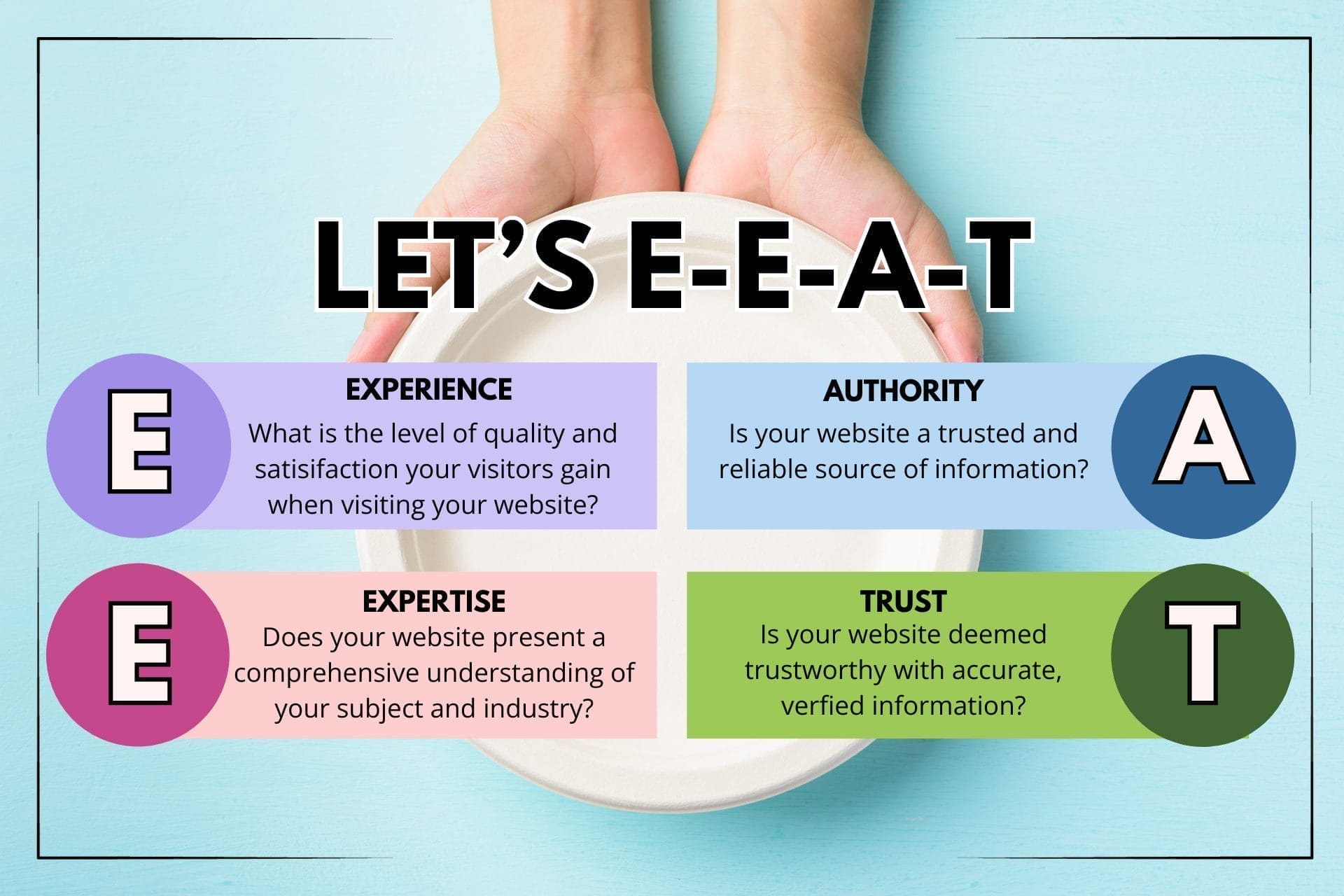
Core Strategic Insight: The Current Definition of E-E-A-T
Today, E-E-A-T is best defined as a comprehensive trust signal that validates a business’s right to speak on a topic. It is the bridge between digital content and professional credibility.
This qualitative framework is used by search systems to evaluate the reliability and value of information and consists of four pillars:
- Experience, which validates first-hand involvement;
- Expertise, which identifies specialized knowledge;
- Authoritativeness, which recognizes a brand or creator as a leading source; and
- Trustworthiness, the most critical component, which assesses the accuracy, safety, and transparency of a website.
Together, these signals help search engines and AI discovery tools distinguish verified professional insights from generic or unverified content.
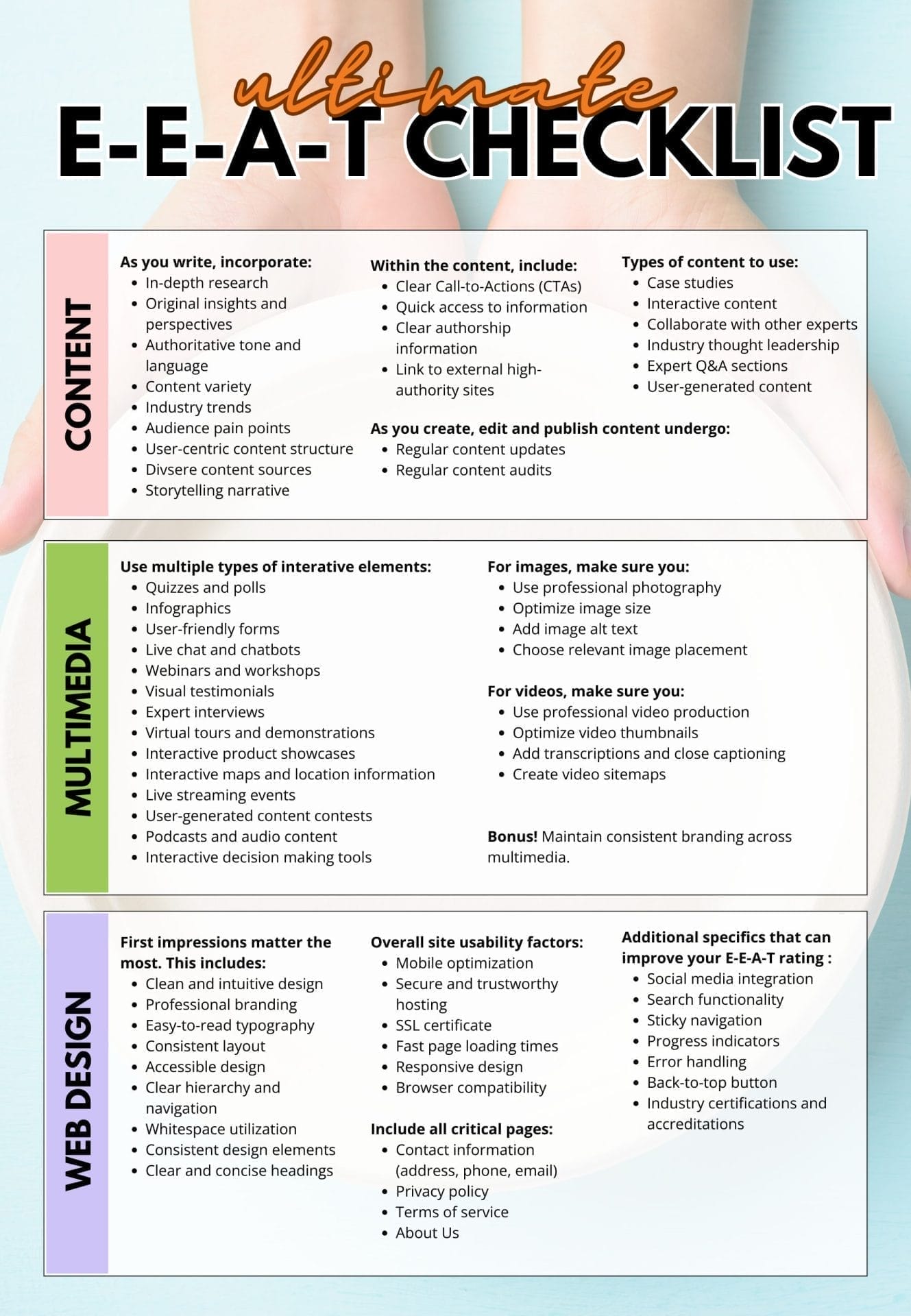
When evaluating your own content, ask these critical questions to determine if you are meeting the standard search engines now require:
- Experience: Does this content show that we have actually done the work? Search engines now prioritize evidence of first-hand involvement. For example, a case study detailing how your team managed a specific project in Ontario carries significantly more weight than a generic article on “how to manage a project.”
- Expertise: Does the content demonstrate a high level of specialized knowledge? This is reflected in the technical depth and accuracy of your insights. It is the difference between providing surface-level tips and offering the nuanced, expert-level detail that only a professional in your field could provide.
- Authoritativeness: Is our brand recognized as a leader or a go-to source for this information? This pillar is built through consistent topic ownership and external validation. When your business is frequently cited by reputable industry sites or local Canadian associations, it confirms your standing as a definitive authority.
- Trustworthiness: Is the information safe, accurate, and honest? As the most critical component, trust is established through transparent business information, secure website protocols (HTTPS), and clear, accountable authorship. If a reader cannot verify who is responsible for the information, they—and search engines—will likely look elsewhere.
Strengthening Your Business Entity Through Off-Page Authority Signals
A common misconception is that E-E-A-T only happens within the text of a blog post. In a modern search environment, Google evaluates your “Entity” far beyond your website. Your business is viewed as a node in a massive knowledge graph.
To strengthen your entity’s authority, search systems look for consistency across:
- Professional Associations: Active memberships in Canadian or industry-specific trade organizations.
- Verified Reviews: Genuine client feedback on third-party platforms that reinforces your service quality.
- Structured Data: Using Schema markup to tell search engines exactly who you are, what you do, and who wrote your content.
- Social Proof: Consistent and professional activity on platforms like LinkedIn or industry-specific forums.
- Media Mentions and Press Recognition: Features or quotes in reputable news outlets or local media.
- Knowledge Graph Consistency: Ensuring your business name, address, phone number, and service offerings are identical across the web.
- Strategic Backlinks and Citations: References from other authoritative, industry-related websites that act as a “vote of confidence” in your expertise.
Practical Ways to Demonstrate Expertise and Trust Within Your Content
For a decision-maker, the challenge is translating the theory of E-E-A-T into tangible site elements. Remember, authority is not claimed, it is demonstrated.
Showcasing the Expert Behind the Content
Every piece of high-stakes content should be associated with a verified professional. This is achieved through detailed author bios that link to LinkedIn profiles, professional certifications, or a portfolio of previous work.
Leveraging Proprietary Data and Case Studies
One of the strongest signals of “Experience” is the use of proprietary information. Sharing anonymous data trends from your industry or publishing detailed case studies provides the “proof of work” that generic AI models cannot replicate.
Curating a “Commonly Asked Questions” Database from Real Leads
Expertise is often demonstrated by answering the questions that generic articles ignore. Create a FAQ section or a “Knowledge Hub” based on actual questions your sales and support teams hear on the phone. By addressing nuanced, high-intent questions (e.g., “How do Canadian tax changes in 2026 affect [Specific Service]?”), you prove to search engines that you are deeply tuned into the current realities of your industry.
Integrating “Micro-Case Studies” and Problem-Solving Briefs
You don’t always need a 10-page whitepaper to show expertise. You can integrate micro-case studies directly into your service pages. These are short, 2–3 sentence blurbs that describe a specific problem a client faced and the exact steps you took to solve it.
Showcasing the “Work in Progress” through Original Visuals
In 2026, original media is a massive signal of “Experience” that AI cannot easily fake. Instead of using stock photos of generic office buildings or handshakes, include annotated screenshots of your specific workflows, photos of your team on-site in Canadian communities, or short video walkthroughs of a complex process. Even a simple photo of a project mid-completion—accompanied by a caption explaining a specific local challenge you overcame—provides the “lived experience” search engines now prioritize.
Identifying Which Industries Must Prioritize High-Stakes Credibility Signals
This strategic focus on E-E-A-T is vital for service-based and lead-generation businesses where the cost of a “wrong” decision is high for the customer.
- Professional Services: Firms in legal, financial, or consulting sectors where expertise is the product.
- B2B Companies: Businesses with long sales cycles that require significant proof of concept.
- Local Service Providers: Canadian businesses looking to dominate their specific geographic market by proving they are the most trusted local option.
The Long-Term Business Risks of Ignoring Authority and Trust Deficits
In a search landscape crowded by AI-generated noise, businesses that fail to prioritize E-E-A-T face a “trust deficit.” Without clear signals of experience, your content risks being categorized as commodity information—useful for a quick answer but insufficient to win a high-value lead. Investing in your authority today creates a defensive moat that protects your visibility against future algorithmic shifts.
Common Questions About Applying E-E-A-T to Small and Mid-Sized Businesses
Navigating the Future of Search Visibility with a Trust-First Strategy
E-E-A-T is the modern standard for digital authority. It reflects a shift away from chasing algorithms and toward a strategy of building genuine, verifiable trust. By focusing on deep topic ownership and clear signals of expertise, your business can navigate the complexities of AI-driven search with confidence.
Establishing this level of authority requires a clear, objective view of your current digital footprint. To understand how your brand currently measures up against these modern standards, consider a strategic SEO Audit to identify opportunities for strengthening your topical authority and visibility.
Still have questions about your site’s authority?
The transition to an AI-first search environment can feel overwhelming, but you don’t have to navigate it alone. Whether you’re concerned about how AI summaries view your brand or you need a roadmap to prove your expertise to Google, we can help. Book a quick 30-minute strategy call with our team to discuss your current visibility and how to turn your industry experience into a permanent search advantage.
Carissa Krause
Carissa Krause is a Digital Marketing and Project Specialist at 1st on the List. Over the last 13+ years she has worked in our Abbotsford office with clients on a wide range of projects that include areas like local SEO, project reporting, backlink profile review, content development, strategic planning, and more. Whatever the project may be Carissa focuses on achieving greater efficiencies and putting plans into action. When away from her desk you’ll likely find her drinking all the coffee while sitting on the floor driving cars with her three young boys.
![A promotional graphic with the text "Is Your SEO Still Working in 2026?" and a blue button labeled "Book a Discovery Call." Below, it says "[No hassle, no pressure, just 30 minutes of insights]." The background has abstract blue shapes.](https://e28vvfjnij8.exactdn.com/wp-content/uploads/2024/09/blog-sidebar-cta-2-1.png?strip=all)
Don’t miss out – get newest posts straight to your inbox!
OTHER ARTICLES WE THINK YOU’LL ENJOY

Partner With Us. Get More Leads.
Stop trying to do it all on your own – reach out to our team and we can discuss marketing strategies that are best suited for your business!
“Your expertise has been a tremendous asset to our company … in the last 6 months of 2024, we had larger average job size, qualified leads and some we didn’t need to bid and compete for.”
“We have seen a steady increase in web traffic and quality leads since first working with 1st on the List. And we continue to see monthly increases through their efforts.”
“They have helped my firm grow organic web traffic month over month and their ongoing support and guidance is something you don’t typically receive from other established competitors.


[NO HASSLE, NO PRESSURE, NO WORRIES – JUST MEANINGFUL INSIGHTS]